User Onboarding
The Account Portal supports customers through their post-purchase experience. As part of the product team, I focused on the software administrator persona, automating user management, seat assignment, software downloads, and subscription renewal workflows to empower users to self-serve these tasks. Onboarding feature, as the first step in their journey, reduced support cases by 30% and laid the foundation for a successful customer experience.
Problem
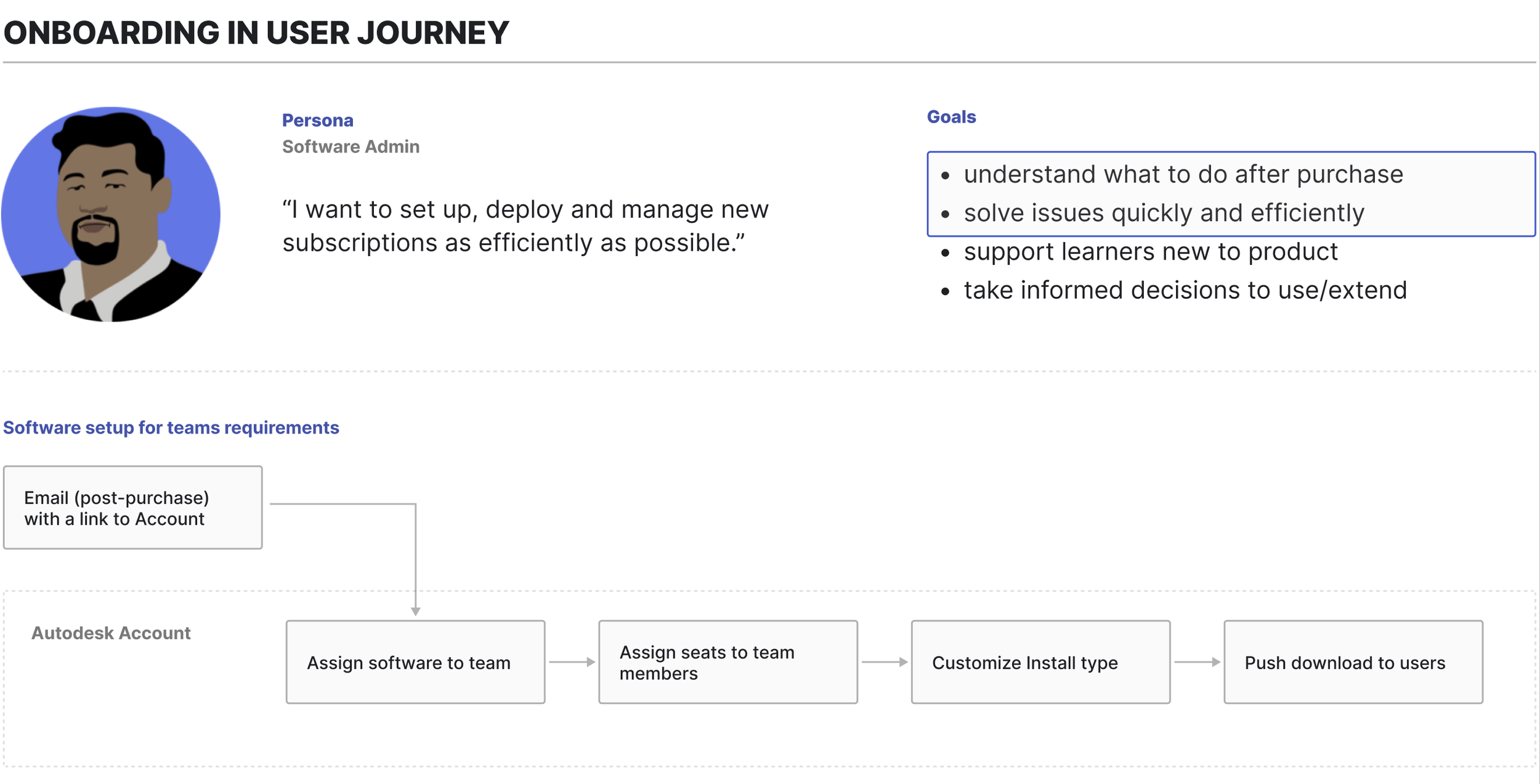
Product onboarding frequently came up as a pain point in user research. The existing onboarding tile on the Account Dashboard was getting only 22% engagement.

“After purchasing software I’m confused about where to go to assign it to teams, download it and install it.”
Goals
As a customer I want to be able to easily set up my newly purchased subscriptions.
As a business we want to create a personalized onboarding feature that guides users through key actions and is seamlessly integrated into the Account architecture to ensure high discoverability.
My role
Identified user needs, conceptualized and designed wireframes, user flows and interactions.
Validated design with users and iterated on the solutions.
Delivered high-fidelity mockups to engineering and supported implementation with design guidance.
Conducted pre-launch QA and identified defects.
Collaborators: Product Manager, Researchers, Engineering.
Process
I mapped out the full onboarding path, but due to technical constraints, we couldn’t implement it all in one release. As a solution, we divided the feature into two phases and handled them separately.
Phase 1: Assign software to a team
Phase 2: Assign users, update license type, access and install
Phase 1 - Assigning software to teams
Requirements
- show the user a list of subscriptions they recently purchased
- allow them to assign the software to an existing team or to create a new one
- direct them to the next step where they can assign seats to individual users
User flow
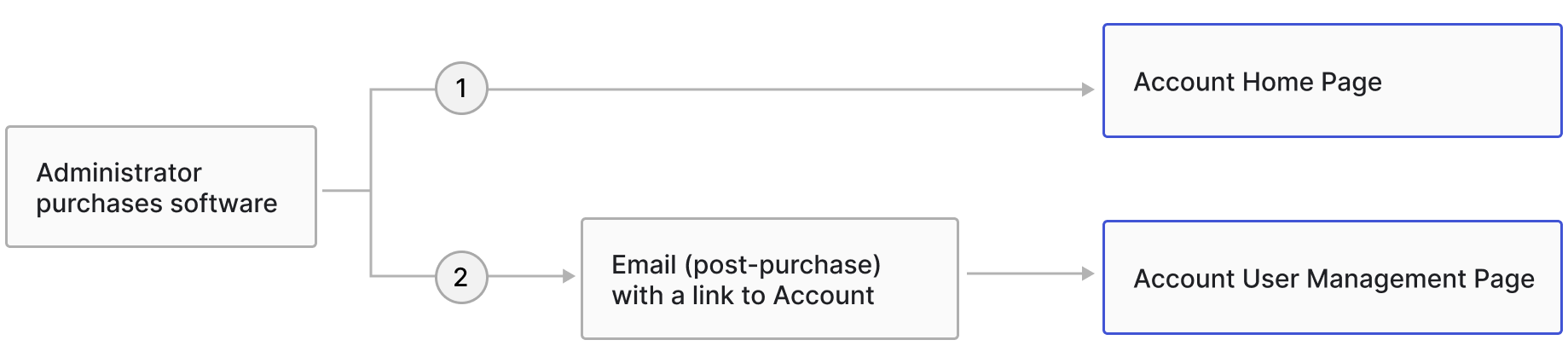
I asked software admins about their post-purchase workflow and identified 2 scenarios.
“I don’t always have time to set it up right away. I often do it later.”
“After a purchase I go to the confirmation email and follow the link to set it up.”
The team agreed that 2 user flows needed to be addressed.
After purchasing software an admin doesn’t follow the link they get in the post purchase email. Instead they log into their Customer Account and land on the Account Home Page where they start the activation journey.
After purchasing software an admin follows the link provided in the post purchase email. The link can take them directly to any page in the account where they should be able to complete team and user assignment.
Flow 1: Implementation of the Onboarding Feature in the Account Home Page
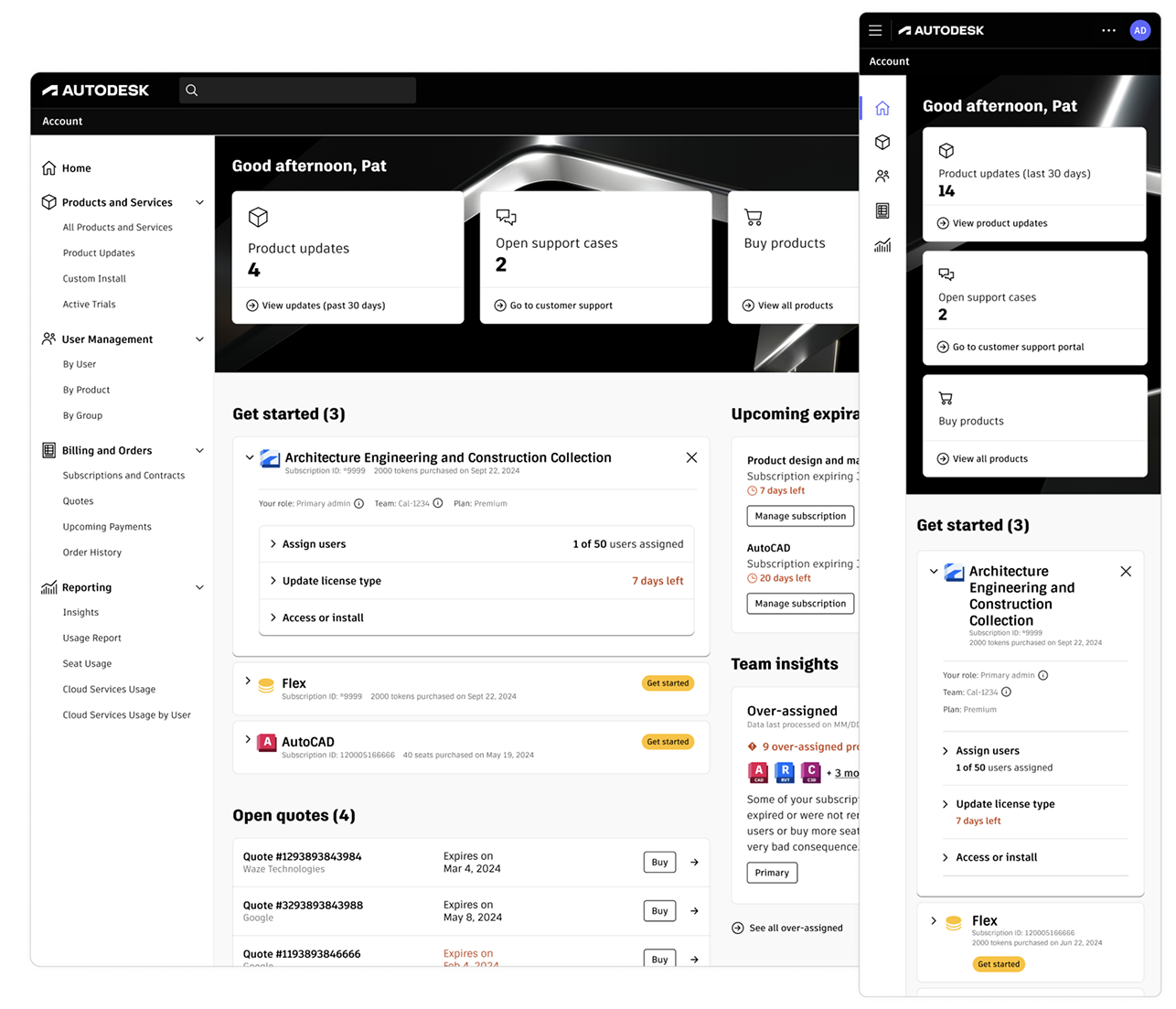
Placement: To ensure high findability of the feature we placed it in the top section of the Account Home Page.
Content presentation: We used an accordion component to display newly purchased subscriptions at a glance, while keeping earlier purchases hidden by default and revealing them on demand when users were ready to engage with them.
Flow: We showed a list of existing teams and gave users the option to create a new one. After they assigned a product to a team, we directed them to the specific team’s page in User Management. The subscription appeared on the list of products assigned to the team. Now the admin could assign the product to individual users.
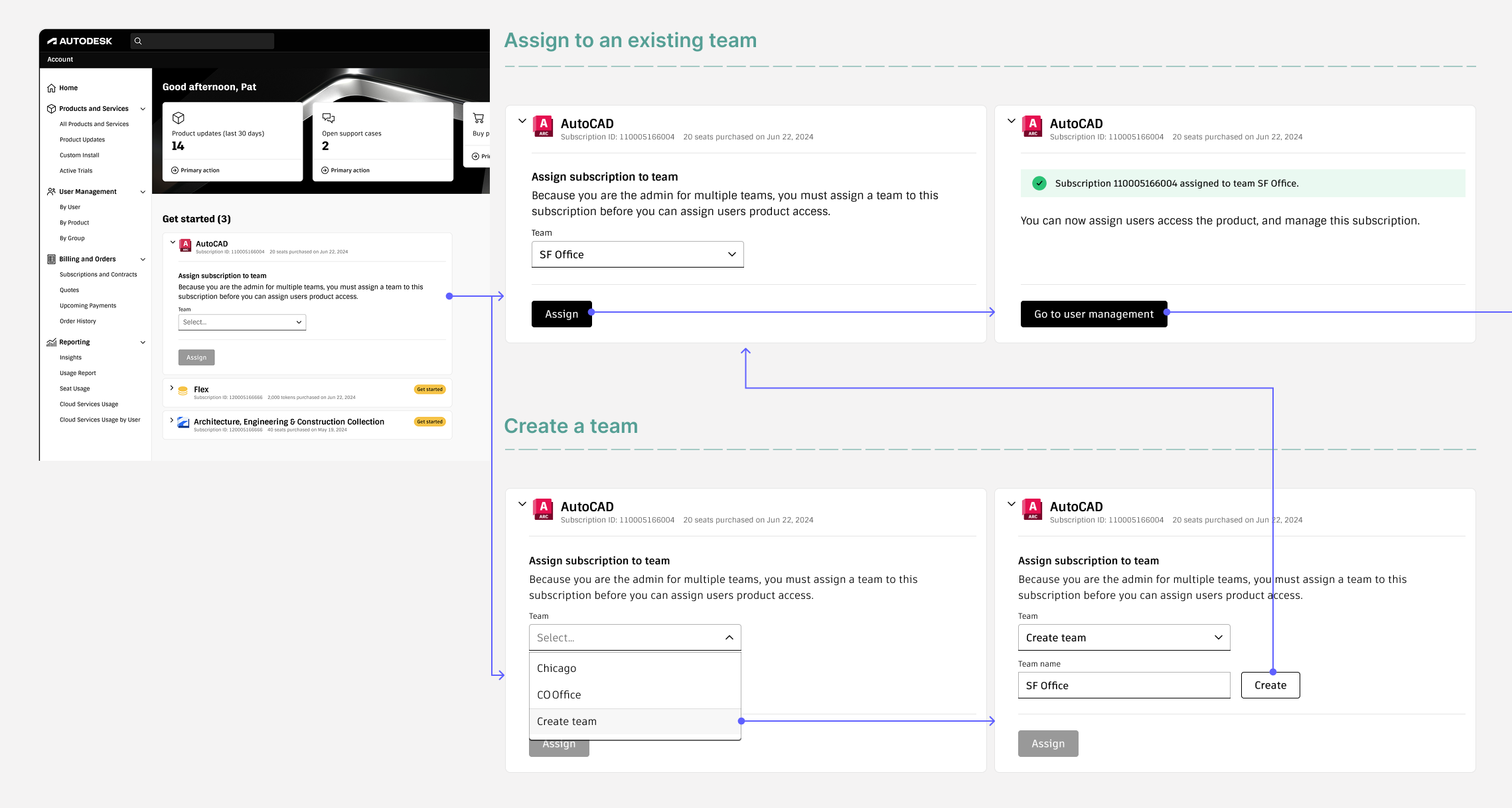
Abbreviated onboarding flow from the Home Page
Flow 2: Implementation of the Onboarding Feature in the Account User Management Page
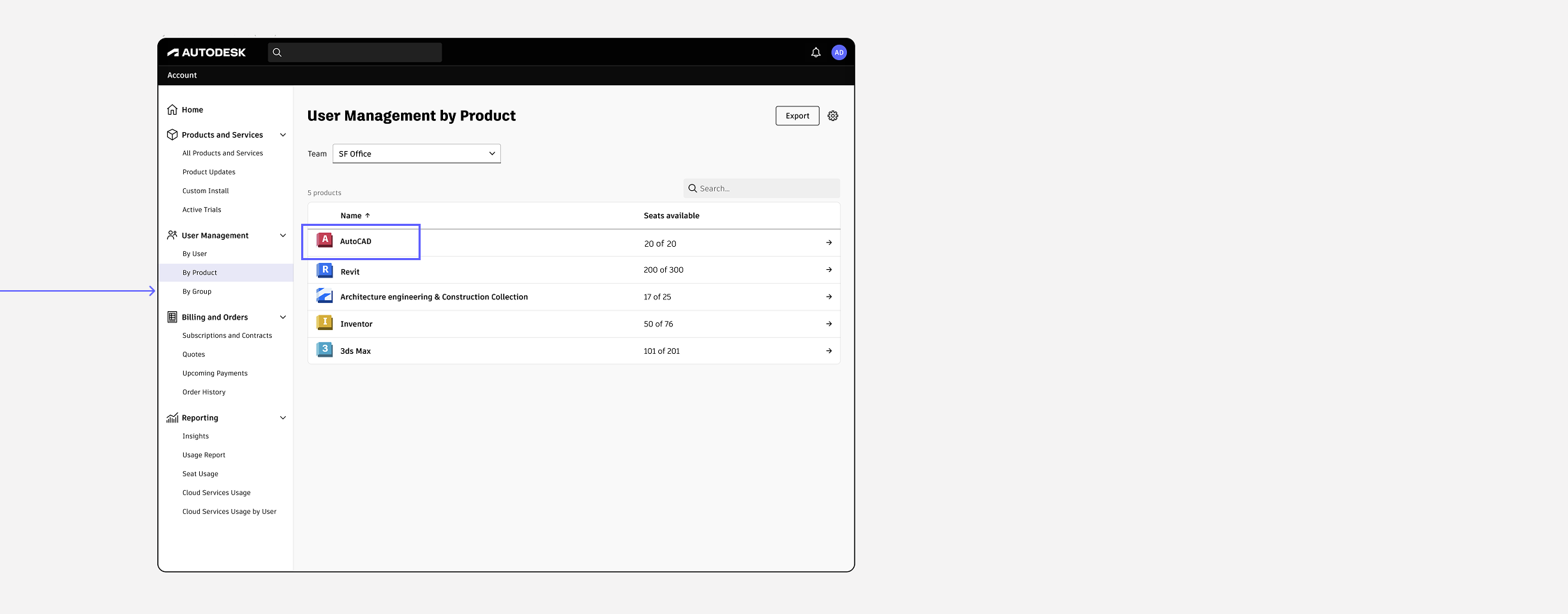
Logic:
An administrator clicks on “Assign Users” in the Autodesk post purchase email.
They land directly on the Account User Management page, where an alert banner prompts them to assign the new product to a team.
A button on the banner opens a modal where they assign the subscription to a team.
After the product is assigned, the modal disappears and the page behind refreshes to show the product in the list. They can now assign individual users to seats.
Through a cycle of design sessions, user validation, and iterative reviews with Content Strategy and Product Management, we arrived at the final design.
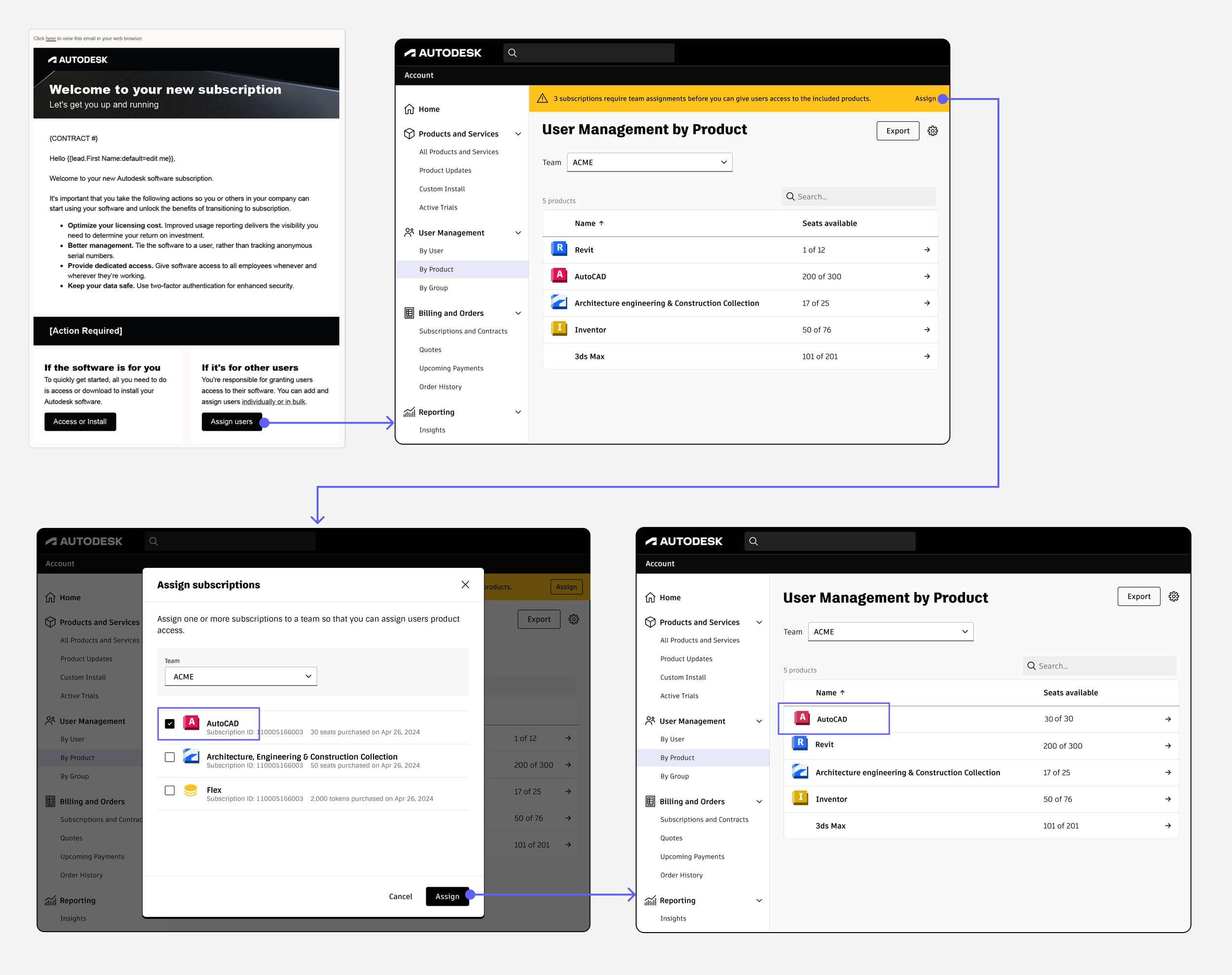
Abbreviated onboarding flow on the By Product Page
Following design hand-off, I supported engineering through implementation, addressing questions such as when and whether users should be able to dismiss the banner. We concluded with User Accessibility/QA Testing identifying defects and logging them into Jira as blockers or backlog items.


Defects examples
Phase 2 - Assign Users, Access and Install
With the initial launch showing positive impact on administrator experience metrics, I moved into automating next steps in the onboarding workflow.

“I want to assign users, install, update licenses and set up SSO as quickly as possible.”
Phase 2 requirements
The module requirements included confirming purchase details, such as the number of seats, purchaser role, plan, subscription, and offering type, and then guiding admins through the remaining setup tasks so they could start using the product.

To solve this, I used an accordion pattern and placed it in a high-visibility section at the top of the account dashboard, where admins land after purchase. Each subscription shows up as a "Get Started" card with the key purchase details up front so the admin can confirm what they bought before proceeding. Expanding the card reveals the relevant actions, like assigning users or accessing/installing the product, each with its own progress indicator (e.g., "1 of 50 users assigned").
This gave the flow a clear hierarchy: confirm the purchase conditions first, then surface only the actions that apply. The experience stays consistent whether an admin is on desktop or a narrower viewport.
After establishing the overall functionality I designed for the range of use cases depending on purchase type.
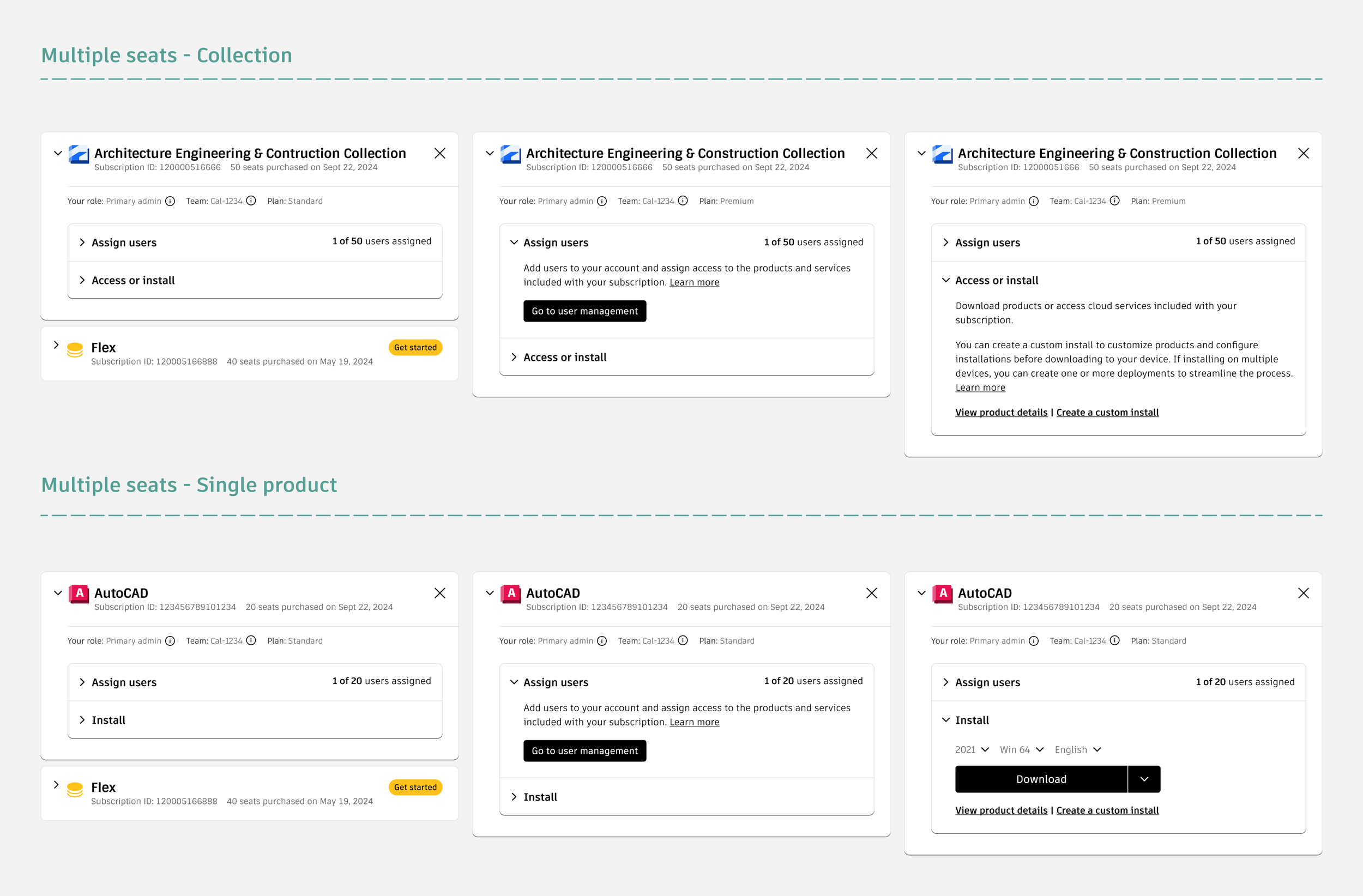
Selected cases with different offering types
Results (8 months post launch)
“Get Started for Admins” onboarding improved the CES (Customer Effort Score) by 80% and the 30-day assignment rate by 8% (4 to 12%).
The move subscription between teams workflow has dropped from 890 to 137 per month.
A 30% reduction in Teams-related support cases was recorded.
Engagement with module increased traffic to Account pages By User +39k, Custom Install +12k, Product detail +20k visits.
Next steps (future state)
Make it easier for the administrators to self-serve by combining the modules into one. Allow them to assign subscriptions to teams and completed the remaining tasks in one flow.
Add the SSO setup capability to the module.
Convert it into a smart component/pattern that can be reused at different customer touchpoints to ensure design consistency and save design and engineering time.